Men's Ties Guide
A men's tie - the necktie - is a length of cloth knotted at the throat over a shirt collar, the single most concentrated dose of pattern and color in classic menswear. Silk ties carry business and ceremony; knit, wool, linen and cotton ties tune the same gesture down toward casual. This guide covers tie construction, width and length against your build and lapels, the essential knots, and the care that keeps silk alive for decades.
Shop Men's Ties Now
Shop Men's Ties on Amazon Shop Men's Ties on eBayThe Amazon and eBay links on this page are affiliate links. If you make a purchase through them, Apparel Search may earn a commission.

A men's tie - the necktie - is a length of cloth knotted at the throat over a shirt collar, the single most concentrated dose of pattern and color in classic menswear. Silk ties carry business and ceremony; knit, wool, linen and cotton ties tune the same gesture down toward casual. This guide covers tie construction, width and length against your build and lapels, the essential knots, and the care that keeps silk alive for decades. This guide is built around the questions buyers actually ask: which style, which size, which fabric, and what will it look like after a year of real use - answered in order, with the trade-offs stated plainly.
Styles and Construction
Construction separates ties that knot beautifully from ties that fight. A quality tie is cut on the bias (at 45 degrees) so it hangs straight without twisting, built from three pieces with a wool-blend interlining that gives the knot its dimple and the blade its recovery, and finished with a self-tipped or silk-tipped blade and a hand-sewn slip stitch that lets the tie flex. Width follows proportion: 3 to 3.25 inches suits most builds and lapels, skinny ties under 2.75 belong to slim frames and narrow lapels, and length (57-58 inches standard, longer for tall men) must land the tip at the belt line. Seven-fold ties - one square of silk folded seven times, minimal interlining - are the connoisseur's extreme: luxurious, delicate, priced accordingly.
Accessories reward material honesty: solid metal over plated base metal, full-grain leather over bonded scraps, stitching over glue wherever fabric or hide is joined. Work every moving part through its full travel before paying - clasps, hinges, springs, adjusters - because small hardware fails before large materials do. And budget the care with the purchase: conditioner, the right cloth, a dry drawer; an accessory you can maintain will outlast a finer one you cannot.
Fit and Sizing
Match the knot to the collar: a four-in-hand (asymmetric, medium) suits standard and button-down collars; a half-Windsor fills a spread collar with a neat triangle; a full Windsor is reserved for wide spreads and formal intent. The tie's wide blade should end at the middle of the belt buckle, the narrow blade shorter and tucked in the keeper loop. Width echo is the quiet rule - tie width near lapel width, knot size near collar spread - and when both are right the whole shirt-and-jacket system looks deliberate.
Accessories have exact fits and exact measures: belt length to the middle hole of a belt you own, hat size as head circumference, a watch case within the wrist's width. Makers' accessory charts vary more than apparel charts, so measure and use the chart rather than ordering a habitual letter - ninety seconds with a tape prevents the most avoidable returns in menswear.
Wearing and Care
Untie a tie properly every time: reverse the knotting steps rather than pulling the narrow end through, which stretches the bias cut. Rest a tie at least a day between wears, rolled loosely or hung, so the interlining recovers. Roll from the narrow end for travel. Keep silk away from food and fragrance spray, spot-clean with a cloth barely dampened, and send serious stains to a cleaner who understands ties - pressing a tie flat at a general cleaner can kill its roll forever.
Store accessories deliberately: leather away from sun and plastic, metal dry, belts rolled or hung by the buckle rather than folded at the same crease forever. Condition leather a few times a year, polish metal with the cloth meant for its finish, and repair hardware early - a loose screw today is a lost cufflink or a failed clasp next month. Rotate daily pieces in pairs and both will outlast a single workhorse.
Common Questions
How wide should a men's tie be?
For most men, 3 to 3.25 inches at the widest point, matched roughly to the width of your jacket lapels and the scale of your frame. Slim builds and narrow lapels take 2.5-2.75 inches; broader builds can carry 3.5. The width question matters more than fashion cycles admit - a tie at war with its lapels dates an outfit instantly.
Which knot should I learn first?
The four-in-hand: it is the easiest to tie, works with most collars, produces a slightly asymmetric knot with a natural dimple, and is never wrong with a button-down or standard point collar. Add the half-Windsor when you wear spread collars, and you own a complete working repertoire for business and formal dressing.
How long should a tie be when tied?
The tip of the wide blade should reach the middle of your belt buckle or waistband - grazing the top of it at shortest, covering it at longest. If a standard 57-inch tie lands wrong, the variables are knot size (a Windsor uses more length) and tie length itself: extra-long ties exist for tall men and larger necks, and using one is tailoring, not vanity.
More in Men's Clothes Guide T
Background and History
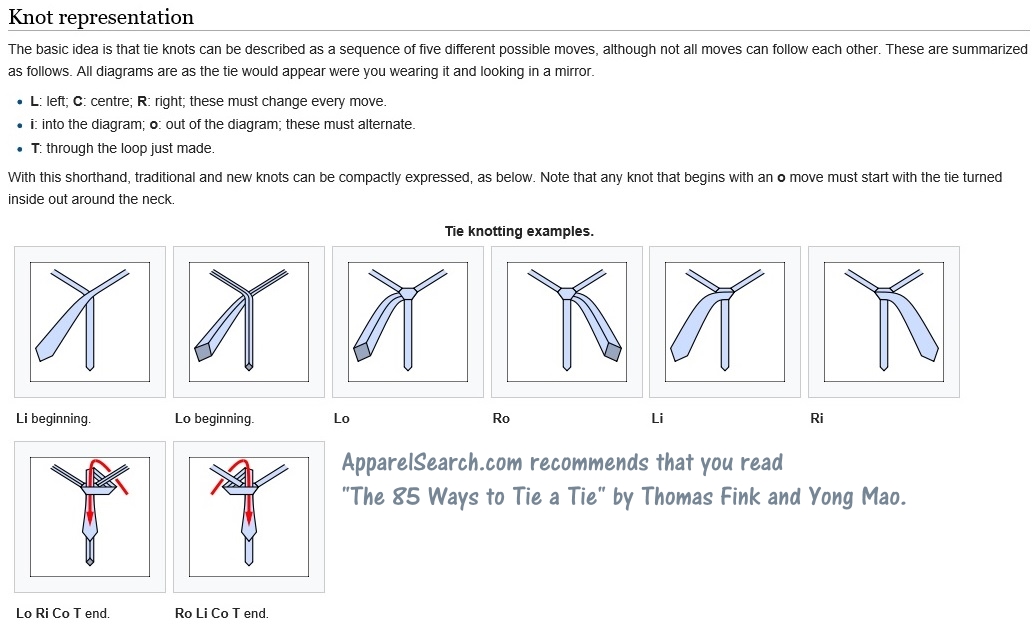
A necktie, or simply tie, is a long piece of cloth worn for decorative purposes around the neck, resting under the shirt collar and knotted at the throat. Variants include the ascot tie, bow tie, bolo tie, zipper tie, cravat and clip-on tie. About knots : A knot is a method of fastening or securing linear material such as rope by tying or interweaving. It may consist of a length of one or several segments of rope, string, webbing, twine, strap, or even chain interwoven such that the line can bind to itself or to some other object (the "load"). Knots have been the subject of interest for their ancient origins, their common uses, and the area of mathematics known as knot theory. About Necktie Knots: There are four main knots used to knot neckties. In rising order of difficulty, they are: four-in-hand knot. The four-in-hand knot may be the most common. Pratt knot (the Shelby knot) half-Windsor knot Windsor knot (also redundantly called the "full Windsor"). The Windsor knot
Photos
Looking for Men's Clothing Stores?
This guide explains men's ties. To browse where to buy, visit our men's clothing store directory, where you can find retailers that carry them.