1870's Period in Fashion History presented by Apparel Search
Fashion Industry Fashion History Color Trend Forecasting Artist Guide Merchandising Fashion Industry News Definition List
|
|
Women's fashions
By 1870, fullness in the skirt had moved to the rear, where elaborate draping was held in place by tapes and supported by a bustle. This fashion required an underskirt, which was heavily trimmed with pleats, ruching, and frills. This fashion was short-lived (though the bustle would return again in the mid-1880s), and was succeeded by a tight-fitting silhouette with fullness as low as the knees: the cuirass bodice, a form-fitting, long-waisted, boned bodice that reached below the hips, and the princess sheath dress or polonaise, a "retro" style based on the fashion of the 1770s.
Evening dresses had low necklines and very short, off-the-shoulder sleeves, and were worn with short gloves. Other characteristic fashions included a velvet ribbon tied high around the neck and trailing behind for evening (the origin of the modern choker necklace).
See also
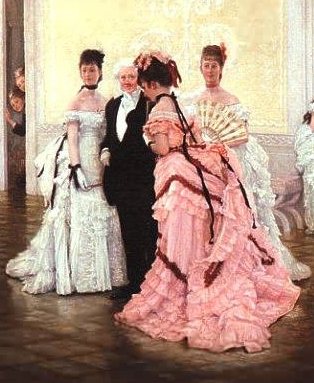
Image: Detail of "Too Early" by James Jacques Tissot (1873). Original in the Guildhall Art Gallery, London.
| The above article is licensed under the GNU Free Documentation License. From Wikipedia, the free encyclopedia https://en.wikipedia.org/wiki/1870s_in_fashion 1/13/06 |
Designer Definition (from U.S Department of Labor)
Learn about another era in fashion:
1980's Fashion History (terms section)
|
|
