1830s
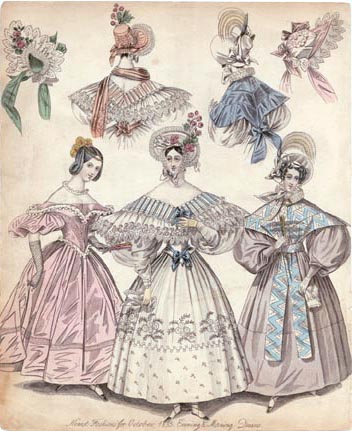
In the 1830s, fashionable
women's clothing styles
had distinctive large "leg
of mutton" or "gigot"
sleeves,
above large full conical
skirts, ideally with a narrow,
low waist between (achieved
through
corseting).
The bulkiness of women's
garments both above and
below the waist was intended
to make the waist look smaller
than it was
this was the final repudiation
of any last lingering aesthetic
influences of the
Empire
silhouette of
ca. 1795-1825. Heavy stiff
fabrics such as
brocades
came back into style, and
many 18th-century gowns
were brought down from attics
and cut up into new garments.
The combination of sloping
shoulders and sleeves which
were very large over most
of the arm (but narrowing
to a small cuff at the wrist)
is quite distinctive to
the day dresses of the 1830s.
Evening dresses had short,
puffed sleeves reaching
to the elbow from a dropped
shoulder and were worn with
mid-length
gloves.
Pelerines, or
lace coverings draped over
the shoulders, were popular
(one of several devices,
along with full upper-arm
sleeves and wide necklines,
to emphasize the shoulders
and their width). Around
1835, the fashionable skirt-length
for middle- and upper-class
women's clothes dropped
from ankle-length to floor-length.
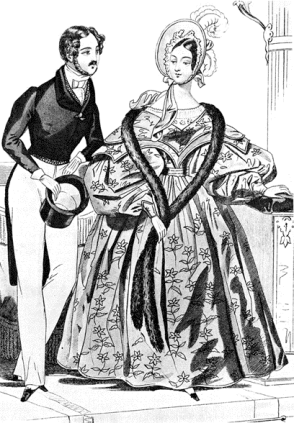
This ca. 1835 fashion
plate shows both male and
female styles (note that
it may not be obvious on
first glance that the woman
has a small waist, because
of her large sleeves):